


Introduction
What Are The Best Amazon PPC Bidding Strategies: Stop Guessing Bids and Start Scaling Profitably
Amazon PPC looks simple until you check your bank account.
You set a bid, but your spend spikes. You follow the "suggested bid," but your ACoS goes through the roof.
Most sellers don't lose money because they are bad at ads. They lose money because they treat bidding like gambling rather than a system.
With that in mind, let’s have a closer look at the best Amazon PPC bidding strategies. Learn how to choose bids that protect your margins and scale your sales with a higher profit margin.
What Are The Best Amazon PPC Bidding Strategies: Stop Guessing Bids and Start Scaling Profitably
Amazon PPC looks simple until you check your bank account.
You set a bid, but your spend spikes. You follow the "suggested bid," but your ACoS goes through the roof.
Most sellers don't lose money because they are bad at ads. They lose money because they treat bidding like gambling rather than a system.
With that in mind, let’s have a closer look at the best Amazon PPC bidding strategies. Learn how to choose bids that protect your margins and scale your sales with a higher profit margin.
Top Amazon PPC Bidding Strategies: 7 Proven Approaches to Maximize Your Ad Performance
Your bidding strategy determines the profitability of your Amazon account management. It doesn't matter if you spend $500 or $50,000 a month. If the strategy is wrong, you are burning cash.
Here are the seven Amazon PPC bidding approaches effective sellers use.
1. Dynamic Bids - Down Only Strategy
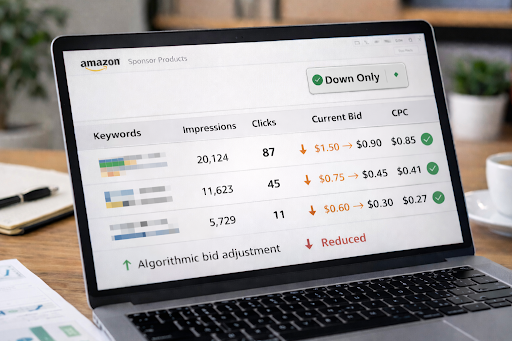
This is the "safe mode."
Amazon automatically lowers your bid if it thinks a click won't lead to a sale. Crucially, it never raises your bid above your limit. You get algorithmic help without the risk of overspending.
Best for:
- Product launches: When you have zero data.
- Tight budgets: If you can't afford a surprise bill.
- Low margins: If your profit is under 30%, use this to stay safe.
Pro Tip: Use "Down Only" for the first 14-21 days of any new campaign. Gather data cheaply. Once you have 10+ conversions, you can switch to something more aggressive.
2. Dynamic Bids - Up and Down Strategy
Amazon's most automated bidding option adjusts your bids in real-time based on conversion probability. The platform can increase bids up to 100% for high-probability clicks and decrease them for low-probability opportunities, maximizing your visibility when it matters most.
Ideal scenarios:
- Established products with proven conversion rates (10% or higher)
- Competitive categories where impression share matters
- Campaigns with at least 2+ weeks of performance data
- Products with 10+ conversions demonstrating market fit
This strategy typically delivers 20-40% more conversions at similar ACoS levels by winning auctions during high-intent shopping moments. The trade-off is less predictable spending patterns, as Amazon can double your bid on promising campaigns.
Example: If you set a $1.50 bid, Amazon might pay $3.00 for a click from a shopper with strong purchase signals (prior cart additions, repeat visits) while paying only $0.75 for browsers with lower intent.
3. Fixed Bid Strategy
With fixed bidding, your bid amount stays constant regardless of conversion likelihood, giving you complete manual control over auction participation. This strategy requires active management but offers the most predictable spending patterns.
Perfect for:
- Experienced PPC managers with 90+ days of historical data
- Sellers who actively optimize campaigns daily
- Situations requiring precise budget forecasting
- Advanced advertisers running sophisticated testing frameworks
Fixed bids work best when you understand exactly what each keyword is worth to your business. Many sellers use this for their top-performing branded keywords where they know the exact cost-per-acquisition they're willing to pay.
Pro Tip: Use fixed bids for your top 20% of keywords where you have extensive performance history. This prevents Amazon from unnecessarily raising bids on already-profitable terms while maintaining your target margins.
4. Placement-Based Multiplier Strategy
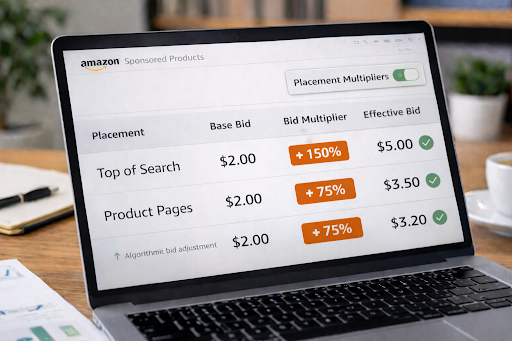
This approach combines any base bidding strategy with percentage adjustments for specific placements, primarily Top of Search (first page results) and Product Pages (competitor listings). Amazon allows multipliers from 0-900%, though most sellers use 50-300%.
When to implement:
- Products with healthy margins (40%+ profit margin)
- Competitive keywords where top placement drives conversions
- Brand defense against competitors targeting your listings
- Monthly budgets exceeding $3,000, allowing placement testing
Research consistently shows that 50-70% of conversions come from Top of Search placements, often justifying aggressive bid increases of 100-200% for these premium positions.
Example: With a $2.00 base bid and a 150% Top of Search adjustment, your effective bid becomes $5.00 for first-page placements while remaining $2.00 for other positions. This concentrates your budget where conversion rates are highest.
5. Performance-Tiered Bidding Strategy
This data-driven approach segments your keywords into performance tiers and assigns different bid levels based on profitability. Instead of treating all keywords equally, you allocate budget proportionally to results.
Tier breakdown:
- High performers (Top 20%): Increase bids 50-100% above baseline
- Medium performers (Middle 60%): Maintain current bid levels
- Low performers (Bottom 20%): Reduce bids 30-50% or pause entirely
Best for:
- Campaigns with 50+ active keywords show varied performance
- Sellers with 30+ days of reliable conversion data
- Advertisers want systematic, repeatable optimization
- Accounts requiring data-driven budget justification
Implementing tiered bidding typically improves overall campaign efficiency by 30-40% by reallocating wasted spend from underperformers to proven winners. Review and adjust tiers every 2-3 weeks as performance evolves.
Pro Tip: Don't completely pause low performers immediately. Reduce their bids by 50% first and monitor for another week. Sometimes keywords just need a lower cost-per-click to become profitable.
6. Dayparting/Time-Based Bidding Strategy
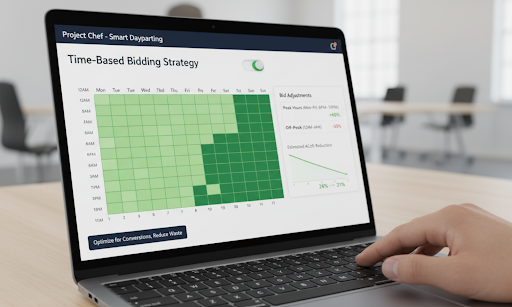
This advanced strategy adjusts bids based on time of day or day of week when your conversions are highest. If your product converts better at 8 PM on weekdays than at 3 AM on weekends, you should bid accordingly.
Implementation requirements:
- Clear conversion time patterns (minimum 500 clicks analyzed)
- Products with predictable time-sensitive demand
- Access to automated bidding tools or rules
- Sufficient budget flexibility for bid adjustments
Increase bids 20-50% during peak conversion hours and decrease them 30-50% during low-performance periods. This typically reduces wasted spend by 15-25% while maintaining conversion volume.
Example: A kitchen gadget seller discovers 65% of conversions happen between 6-10 PM EST on weekdays. They increase bids 40% during these hours and reduce bids 35% from midnight to 6 AM, cutting ACoS from 28% to 21% within 30 days.
7. Portfolio Budget Optimization Strategy
This isn't about a single keyword. It's about how you split the pie across your whole account.
The Framework:
- Brand Defense: 15-20% of budget. (Conservative bids).
- High-Intent Keywords: 40-50% of budget. (Aggressive bids).
- Discovery (Broad/Auto): 20-25% of budget. (Low bids).
- Retargeting: 10-15% of budget.
This prevents you from spending your whole budget on "awareness" ads while starving your profitable keywords.
Pro Tip: Track whether your portfolio allocation is actually working with our TACoS Calculator. It shows organic sales as a % of total revenue, not just ad efficiency.
Comparison: The 7 Best Strategies at a Glance
Quick Decision Framework: Choosing Your Optimal Strategy
Select Dynamic Down Only when: You're launching new products, operating on limited budgets ($500-$10,000/month), have minimal PPC experience, or manage products with thin margins (under 30%).
Select Dynamic Up and Down when: Your product shows proven conversion rates (10%+), you compete in crowded niches, you want maximum visibility, or you have moderate budgets ($3,000-$30,000/month).
Select Fixed Bids when: You possess extensive PPC data (90+ days), actively manage campaigns daily, require predictable spending patterns, or operate as an experienced PPC professional.
Select Placement Multipliers when: Your margins support aggressive bidding (40%+), Top of Search demonstrably converts better, you're defending against competitor attacks, or you have budgets exceeding $10,000/month.
Select Performance-Tiered Bidding when: You manage 50+ active keywords, performance varies significantly across terms, you want systematic optimization processes, or you've accumulated sufficient historical data.
Select Dayparting when: You've identified clear conversion time patterns, your product has time-sensitive demand characteristics, you want to maximize budget efficiency, or you have automated bidding tools available.
Select Portfolio Optimization when: You operate multiple campaign types simultaneously, you need balanced brand and performance marketing, you manage large product catalogs, or your monthly budget exceeds $20,000.
Remember, the best bidding strategy evolves with your product lifecycle. Start conservative, gather data, then scale aggressively based on performance.
Amazon PPC Bidding Mistakes: Costly Errors Draining Your Ad Budget
Even experienced sellers make bidding mistakes that quietly drain thousands of dollars from their advertising budgets. Here are the most common pitfalls and exactly how to avoid them:
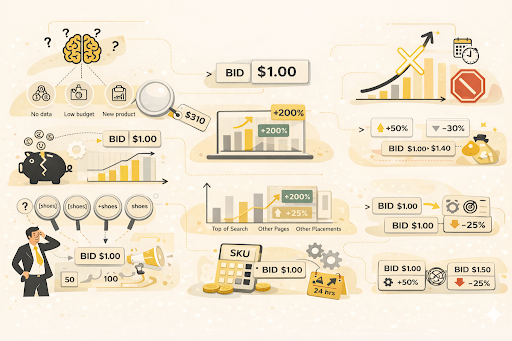
Setting Initial Bids Without Market Research
Guessing your starting bids is the fastest way to either waste money or get zero impressions. Many sellers arbitrarily choose $0.50 or $1.00 without understanding their category's competitive landscape.
The smarter approach:
- Check Amazon's suggested bid range for your target keywords
- Start at the lower end of this range for new campaigns
- Adjust based on performance data after 7-10 days
- Use tools like Helium10 or Jungle Scout to research competitor bid estimates before launching
Ignoring Placement Performance Data
Your ads perform differently across Top of Search, Product Pages, and Rest of Search placements. Running identical bids across all placements means you're overpaying in some areas and underperforming in others.
Optimize placement bids properly:
- Collect at least 100+ clicks before analyzing placement reports
- Review your placement report in Campaign Manager weekly
- Increase the Top of Search multiplier to 100-200% if it converts significantly better
- Reduce product page bids if conversion rates are below 3%
- Monitor placement performance during optimization phases
Using the Same Bid for All Match Types
Exact match keywords have proven buyer intent, while broad match casts a wide discovery net. Bidding the same amount for both wastes budget on low-intent broad match clicks.
Match type bidding strategy:
- Create separate campaigns or ad groups for each match type
- Bid 40-60% higher on exact match (known converters)
- Maintain moderate bids on phrase match for balance
- Bid 30-50% lower on broad match for discovery purposes
- Allocate the budget proportionally to conversion likelihood
Changing Bidding Strategies Too Quickly
Switching from Dynamic Down Only to Fixed Bids after just 3 days doesn't give Amazon's algorithm enough data to optimize. Premature strategy changes reset your learning period and prevent meaningful insights.
Give strategies time to work:
- Commit to any bidding strategy for a minimum of 14-21 days
- Collect at least 10 conversions and 200+ clicks before making changes
- Document performance weekly, but resist short-term panic adjustments
- Look for consistent trends over 2-3 weeks, not daily fluctuations
- Set calendar reminders for strategy review dates
Applying Dynamic Up & Down to Brand Defense Campaigns
Using aggressive bidding on your own branded keywords is unnecessary; you likely already rank organically. Dynamic Up & Down can double your bids on terms where you'd win anyway at lower costs.
Brand campaign bidding best practices:
- Use Fixed Bids or Dynamic Down Only for branded campaigns
- Set conservative bids 20-30% below non-branded campaigns
- Focus on defending position efficiently, not maximizing impression share
- Monitor competitor encroachment, not your own organic rank
- Allocate saved budget to high-intent non-branded keywords
Ignoring Profit Margins in Bid Calculations
Bidding $2.50 on a product with only an $8 profit margin means you’re risking 31% of your total profit on every single click. Without margin-based bid limits tied to your conversion rate, you can win clicks, generate sales, and still lose money.
Calculate maximum bids based on profitability:
- Use this formula: (Product Price × Target ACoS%) ÷ Expected Conversion Rate = Max Bid
- Example: $30 product with 25% target ACoS and 5% conversion rate = $1.50 maximum bid
- Build a spreadsheet with margin-based bid limits for each product
- Never exceed your calculated maximum bid, regardless of competition
- Revisit calculations monthly as conversion rates stabilize
Use our free ACoS Calculator to find your current ACoS before setting bid limits.
Forgetting Bid Adjustments During Promotions
Running a Lightning Deal or coupon increases your conversion rate, but maintaining normal bids means you're leaving sales on the table during high-intent periods.
Promotional period bidding tactics:
- Increase bids by 30-50% during promotional periods (Prime Day, Black Friday, Lightning Deals)
- Schedule bid increases 24 hours before promotions start
- Higher conversion rates justify temporarily aggressive bidding
- Set calendar alerts to decrease bids immediately after promotions end
- Track promotional ACoS separately to measure true campaign performance
Mixing Incompatible Strategies Across Related Campaigns
Running Dynamic Up & Down on your auto campaign while using Fixed Bids on manual campaigns for the same product creates budget conflicts. Campaigns compete against each other, driving up your overall costs.
Coordinate campaigns strategically:
- Align bidding strategies across campaigns targeting the same product
- If testing multiple approaches, target distinctly different keyword sets
- Use negative keywords to prevent campaign cannibalization
- Review search term reports to identify overlap between campaigns
- Consolidate similar campaigns when they're competing for the same auctions
Most bidding mistakes stem from impatience and insufficient data analysis. Set clear testing timelines, monitor metrics weekly, and make incremental adjustments rather than dramatic strategy overhauls.
Turn Amazon PPC Bidding Into A Predictable Growth Engine
Amazon PPC growth doesn't come from higher bids or chasing competitors; it comes from choosing the right bidding strategy at the right stage, grounded in data, margins, and clear rules.
When bidding becomes a system, ACoS stabilizes, waste drops, and scaling becomes deliberate instead of reactive. Test conservatively, double down on proven performers, and evolve bids as your products mature.
If you want to turn these frameworks into consistent, scalable results, we apply this exact bidding discipline every day at Olifant Digital, helping brands stop guessing, protect margins, and grow Amazon revenue with a high profit margin.